![UrbanSDK_primary_logo_horizontal_white.png]](https://urbansdk-9267502.hs-sites.com/hs-fs/hubfs/UrbanSDK_primary_logo_horizontal_white.png?height=40&name=UrbanSDK_primary_logo_horizontal_white.png)
Introduction
Traffic speed metrics are collected from vehicle navigation devices for every hour of day and quantify the speed at which vehicles travel along a road segment.
Traffic speed is one of the most important factors in road safety: evidence from collision analysis and the Vision Zero road design philosophy shows traffic speed is the single most important determinant of both the likelihood and severity of a collision, with the probability of a pedestrian fatality rising from 10% at 20 mph to 50% at 30 mph, 80% at 40 mph, and near-certainty at 50 mph. Because of this, traffic speed data supports a wide range of use cases — targeting traffic calming interventions and focusing speed enforcement where speed limits and road design don't align.
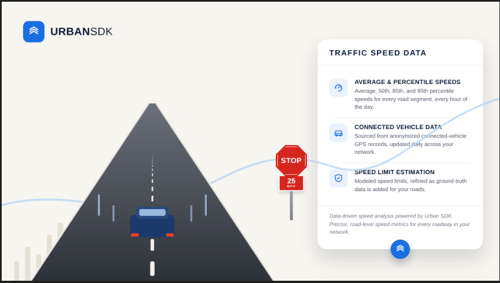
Urban SDK provides the following metrics on all roads for functional classes 1–5 in the road network:
- Average Speed
- 50th Percentile Speed
- 85th Percentile Speed
- 95th Percentile Speed
- Speed Limit
Methodology
Data Collection
Urban SDK's traffic speed data begins with navigation devices installed in connected vehicles (CVs), which have become nearly ubiquitous in vehicles on the road today. As these vehicles travel across the transportation network, they generate anonymized, geocoded, and timestamped records of their location, direction of travel, and speed — provided to Urban SDK in 15-minute intervals. Each location ping is tagged to the nearest road link over which the vehicle is traveling. This data is collected for every hour of every day throughout the year, producing a continuous sample of trip speed observations on every public roadway in your community.
The relative share of connected vehicles compared to total traffic volume — Urban SDK's data "penetration rate" — varies across the transportation network. Penetration typically runs 15–35%, averaging about 25%, well past the threshold for a representative sample. Because traffic speeds are strongly correlated with road geometry, and traffic naturally follows a "vehicle-following" pattern (vehicles on the same road segment tend to travel at similar speeds), this level of penetration is more than sufficient to produce an accurate picture of typical traffic speeds on a road segment.
⚠️NOTE: On rare occasions where the number of trips travelling along a road is exceptionally low, the provided value will be null. These are typically in rural areas, and during times of the day where there is little to no traffic volume (i.e. if there are no trips to observe, there will be no speed observations to report).
Data Processing
Urban SDK compiles these geocoded, timestamped speed records into statistical distributions of the speeds at which traffic flows on each road segment within our Linear Referencing System (LRS), for any given time period. This statistical analysis is what generates the Average, 50th Percentile, 85th Percentile, and 95th Percentile speed metrics described below.
The raw data collected can be very large and difficult to work with for traffic analysis — the amount of data collected in a major city for a single day would be too large to manage with conventional tools like Excel or Access, let alone a full year's worth. For this reason, Urban SDK aggregates the data to hourly intervals, Weekdays, Weekends, AM Peak, PM Peak, and processes Traffic Speed metrics into a format that can easily be queried, analyzed, and downloaded without requiring complex database storage on your network.
- Average Speed: Average Speed quantifies the average speed of observed trips along a road segment. It is provided in miles per hour (mph).
- 50th Percentile Speed: Otherwise known as the median speed, where half of the observed vehicles travel at or below, and half travel faster.
- 85th Percentile Speed: 85th Percentile Speed quantifies the speed at or below which 85% of observed trips travel along a road segment. It is provided in miles per hour (mph).
- 95th Percentile Speed: The speed at or below which 95% of observed trips travel along a road segment. It is provided in miles per hour (mph).
- Speed Limit: Represents Urban SDK Speed Limits unless custom speed limits have been integrated, which then take precedence. The Urban SDK Speed Limit provides an estimate of what a reasonable speed limit would be on a road, within +/- 5mph. It is provided in miles per hour (mph).
-
- How Urban SDK Speed Limit is Calculated: Urban SDK Speed Limit is a model which provides a best estimate of posted speed limits on road links for which no ground truth speed limit is available. We use a combination of the road functional class, speed category information provided by the raw data provider, and off-peak observed average travel speeds to estimate Urban SDK Speed Limit. As we continue to receive ground truth speed limit data from our customers within their boundaries, we are refining and updating Urban SDK Speed Limit to improve our level of accuracy in estimating posted speed limits with this metric.
Data Specification
Metadata Fields
Metadata fields that are provided for all data are detailed in Urban SDK's Linear Referencing System (LRS) specification.
Data Fields
The following table is the format in which downloaded Traffic Speed data will be provided:
| Field | Type | Description |
|
|
integer | The year associated with the provided data. |
|
|
integer | The month associated with the provided data as an integer between 1 and 12. |
|
|
integer |
The period of day associated with the provided data, as an integer between 1 and 3: AM Peak (7am–9am), PM Peak (4pm–6pm), 12 Hours (AM or PM). |
|
|
integer |
The hour of day associated with the provided data as an integer between 1 and 24. |
|
|
string |
Identifies which data is provided:
|
|
|
integer |
Urban SDK Speed Limits unless custom speed limits have been integrated, which then take precedence. |
|
|
numeric |
The calculated value for Mondays within the selected period. |
|
|
numeric |
The calculated value for Tuesdays within the selected period. |
|
|
numeric |
The calculated value for Wednesdays within the selected period. |
|
|
numeric |
The calculated value for Thursdays within the selected period. |
|
|
numeric |
The calculated value for Fridays within the selected period. |
|
|
numeric |
The calculated value for Saturdays within the selected period. |
|
|
numeric |
The calculated value for Sundays within the selected period. |
|
|
numeric |
The calculated value for Weekdays (Monday-Friday) within the selected period. |
|
|
numeric |
The calculated value for Weekend (Saturday-Sunday) days within the selected period. |
Urban SDK Value: Urban SDK deaggregates the data to hourly intervals, or to one of the daily periods described in Section 3.0, and processes Traffic Speed metrics into a format that can easily be queried, analyzed, and downloaded without requiring complex database storage on your network.